
Combining AI and OR/MS for Better Trustworthy Decision Making – Bridge Program


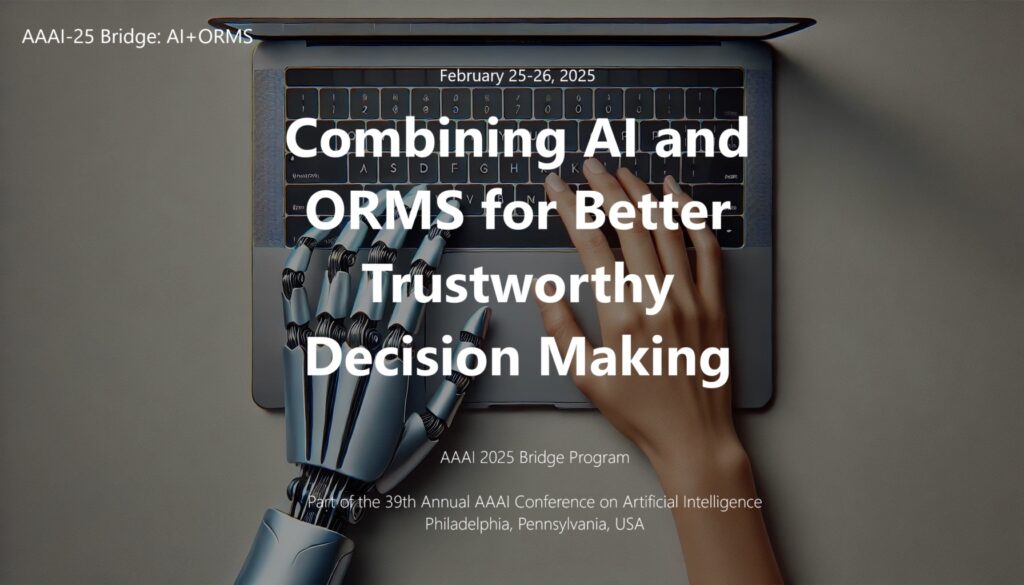
AAAI-25 Bridge: AI+ORMS
Combining AI and OR/MS for Better Trustworthy Decision Making
Part of the 39th Annual AAAI Conference on Artificial Intelligence | Philadelphia, Pennsylvania, USA
Description of the Bridge Program
Artificial Intelligence (AI), including Generative AI, and Operations Research/Management Science (OR/MS) offer proven but distinct approaches to decision-making with data and models. However, challenges persist in applying them to vital socio-technical environments where human and artificial systems interact. These include the need to combine AI and OR/MS for the best solution, aligning models with human values and promoting trust, and the expertise and time required for their application, which limit wider use.
Main Objectives
It is the goal of this bridge program to unite AI and OR/MS practitioners and researchers to improve trustworthy decision-making in key socio-technical areas such as supply chains, healthcare, crisis management, homeland security, robotics, wildlife conservation, medicine, transportation, and finance. It aims to equip them with better tools by familiarizing them with each other’s techniques and domains, and bringing the disciplines together to advance the research and application at the intersection of AI and OR/MS so as to improve decision-making.
Topics
- Utilizing AI, OR/MS, and their integration for decision-making.
- Exploring current state-of-the-art research and identifying new directions in combining AI and OR/MS for improved trustworthy decision-making, including integrating Large Language Models with OR/MS and other AI tools to democratize advanced decision-making capabilities and integrating OR/MS and AI to improve trustworthiness.
- Identifying key domains and use cases where AI and OR/MS can improve decision-making.
Format of the Bridge Program
This will be a two day bridge, which will include: a half day of invited talks and a tutorial on using OR/MS for decision-making; a half day of submitted presentations and posters on applying AI and/or OR/MS and state-of-the-art research on their integration for trustworthy decision-making; a half day of presentations on future research directions and key domains for AI and OR/MS integration; and a half day of discussions to refine research priorities and focus use cases, and define next steps.
Attendance
Attendance is open to any interested students, practitioners and researchers.
Submission Requirements
Participants interested in presenting can submit a presentation proposal about one or more of the following:
- An application of AI and/or OR/MS (individually or together) to decision-making.
- Existing research integrating AI and OR/MS for decision-making.
- New, important research directions that integrate AI and OR/MS for decision-making.
- Decision-making domains and use cases where AI and OR/MS should be jointly applied, with a rationale for the combined approach.
- Relevant surveys presentation.
Submissions can range from a one-page abstract to a full journal article and may include work at any level of maturity, as well as previously published work.
Submission Site Information:
Previously unpublished mature application work may be invited to submit a version to an accelerated review process for a special issue of the INFORMS Journal on Applied Analytics. Previously unpublished mature research work may be invited to submit a version to an accelerated review process for a special issue of the INFORMS Journal on Computing . Research work, survey papers and proposals on applications may be invited to submit a version to the INFORMS Journal on Data Science.
Timetable for Authors
- November 25, 2024: Bridge Submissions Due to Organizers
December 9December 16, 2024: Notifications Sent to Authors- December 19, 2024: AAAI-25 Early Registration Deadline
- January 13, 2025: All Materials for Participants Posted by Organizers
- February 25-26, 2025: AAAI-25 Bridge Program
Keynotes
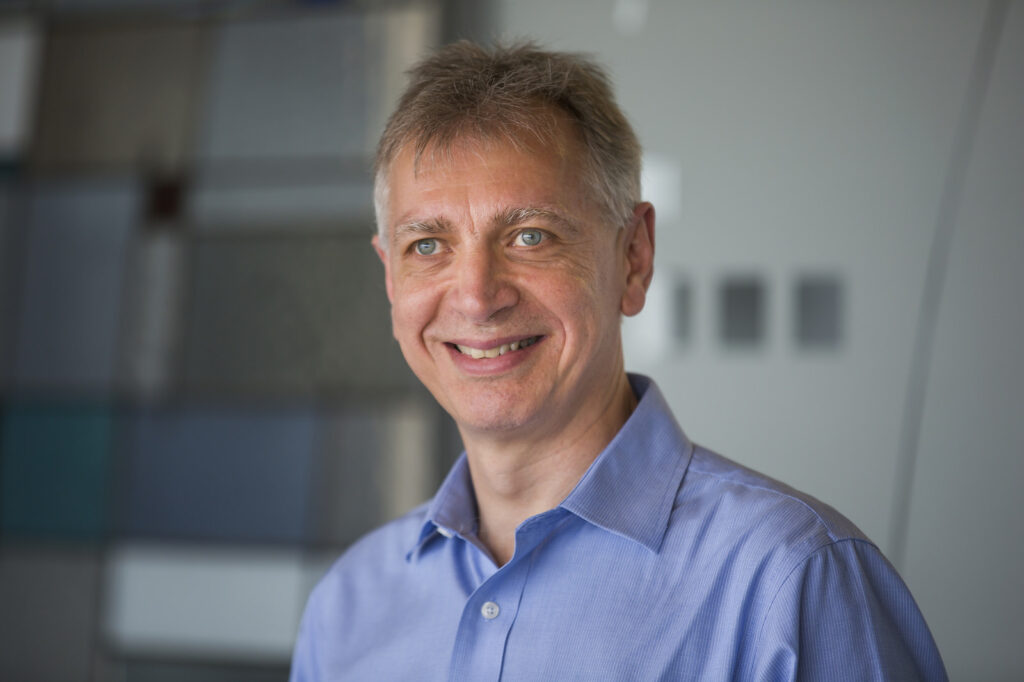
Prof. Pascal van Hentenryck, Georgia Tech and Director of the NSF AI Institute for Advances in Optimization
Title: “Fusing AI and OR for Engineering: Theoretical Results and Industrial Impact”
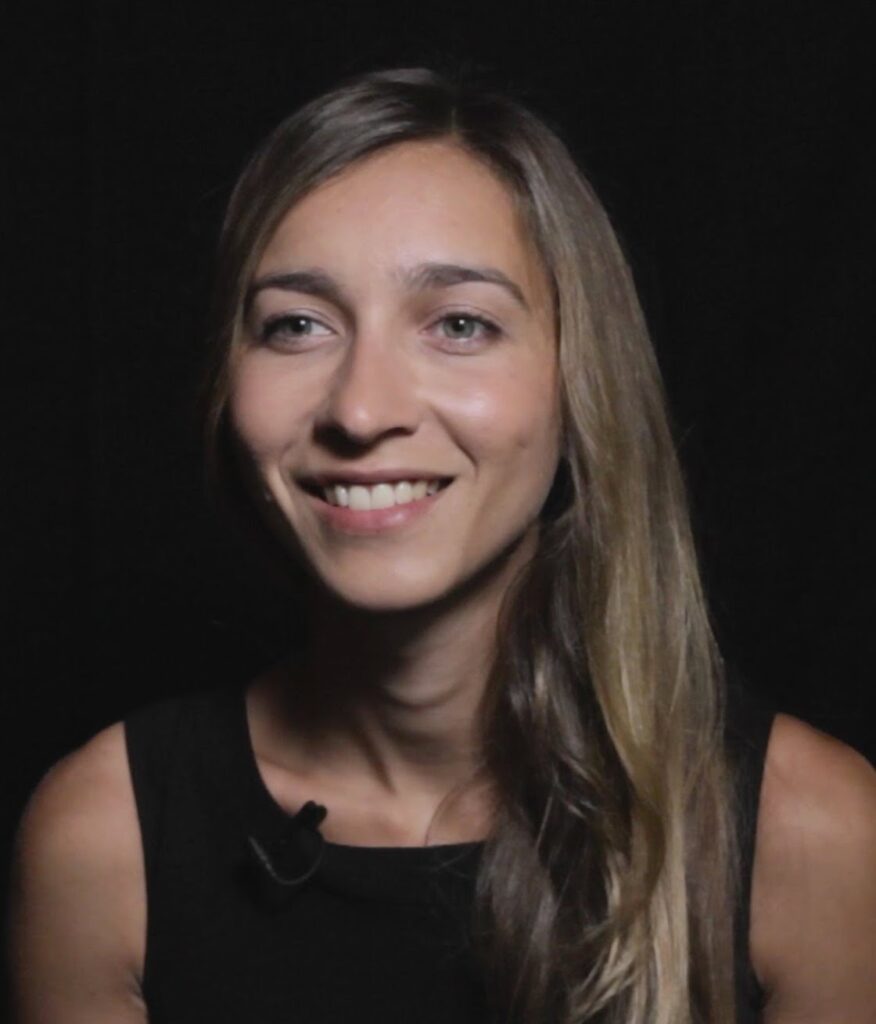
Prof. Phebe Vayanos, University of Southern California
Title: “Integrating AI with OR for Responsible Decision-Making in Homeless Services Provision: Transparency, Robustness, and Fairness”
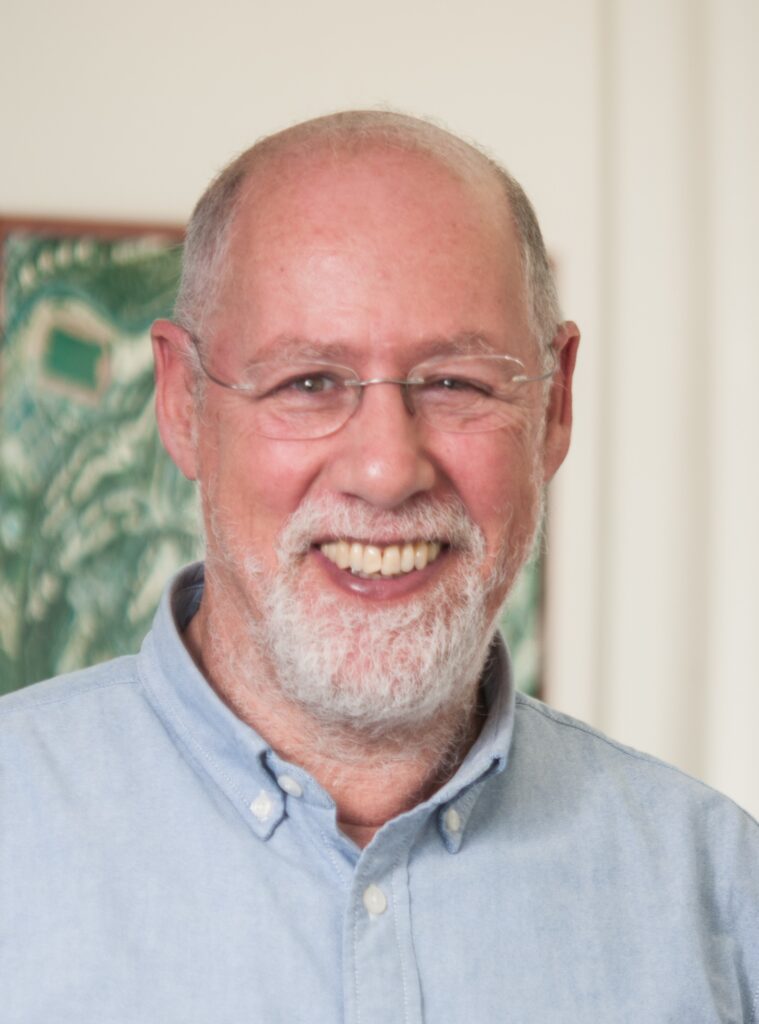
Prof. Avishai Mandelbaum, Technion
Title: “From Small Measurements through AI/ML to OR/MS: Theompirical Adventures in Service Systems”
Schedule
Bridge Agenda
February 25, 2025 (Day 1)
| 09:00-09:15 | Bridge Kickoff and Introductions |
| 09:15-10:15 | Keynote: “Integrating AI with OR for Responsible Decision-Making in Homeless Services Provision: Transparency, Robustness, and Fairness” Prof. Phebe Vayanos |
| 10:15-10:30 | Poster Session 1: 1 minute introductions |
| 10:30-11:00 | Break |
| 11:00-12:30 | Session 1: • “The Indispensable Role of Causality in Building Resilient Supply Chains”, Karthika Mohan, Rashila Lamichhane and Chi Zhang. • “A General Control-Theoretic Approach for Reinforcement Learning: Theory and Algorithms”, Weiqin Chen, Mark S. Squillante, Chai Wah Wu and Santiago Paternain • “A Deployment Study of a Data-Driven Volunteer Engagement System for Food Security”, Zheyuan Ryan Shi, Ameesh Kapoor, Anthony Levin-Decanini, Sean Hudson, Leah Lizarondo, Rayid Ghani and Fei Fang • “Toward Modeling Assistants: Bridging Natural Language and Constraint Models”, Karthik Uppuluri, Serdar Kadioglu and Akash Singirikonda • “Domain-Independent Dynamic Programming”, Ryo Kuroiwa and J. Christopher Beck • “Multi-Agent Path Finding in Continuous Spaces with Projected Diffusion Models”, Jinhao Liang, Jacob Christopher, Sven Koenig and Ferdinando Fioretto |
| 12:30-14:00 | Lunch |
| 14:00-15:00 | Keynote: “From Small Measurements through AI/ML to OR/MS: Theompirical Adventures in Service Systems”. Prof. Avishai Mandelbaum |
| 15:00-16:00 | Poster Session 1 & Demo session (Continue into break) |
| 15:30-16:00 | Break |
| 16:00-17:00 | Session 2: • “A Bridge Between OR and AI: POMDPs and Nonlinear Filtering”, Eugene Feinberg and Pavlo Kasyanov • “Confidence-Aware Deep Learning for Load Plan Adjustments in the Parcel Service Industry”, Thomas Bruys, Reza Zandehshahvar, Amira Hijazi and Pascal Van Hentenryck • “Linear Shipping Network Design with Reinforcement Learning”, Utsav Dutta, Yifan Lin and Zhaoyang Larry Jin • “Rack Position Optimization in Large-Scale Heterogeneous Data Centers”, Chang-Lin Chen, Jiayu Chen, Tian Lan, Zhaoxia Zhou, Hongbo Dong and Vaneet Aggarwal |
February 26, 2025 (Day 2)
| 09:00-09:15 | Day 1 Summary and Day 2 kickoff |
| 09:15-10:15 | Keynote: “Fusing AI and OR for Engineering: Theoretical Results and Industrial Impact”. Prof. Pascal Van Hentenryck |
| 10:15-10:25 | Poster Session 2: 1 minute introduction |
| 10:25-11:00 | Poster Session 2 |
| 10:30-11:00 | Break |
| 11:00-11:45 | Research directions proposals presentations • “Trust Calibration through Explainable Optimization Reasoning”, Claudia Goldman • “Democratizing Decision Optimization through Large Language Models”, Léonard Boussioux, Dick den Hertog, Connor Lawless, Farzaneh Mirzazadeh, Madeleine Udell, Segev Wasserkrug and Alexander Zadorojniy • “Distributional MIPLIB: a Multi-Domain Library for Advancing ML-Guided MILP Methods”, Weimin Huang, Taoan Huang, Aaron Ferber and Bistra Dilkina |
| 11:45-12:30 | Challenge Problem Proposal Presentations • “Robotics & OR”, Sven Keonig • “AI and OR for Supply Chain”, Karthika Mohan • “Machine Learning and Optimization for Decarbonizing High-Emitting Industries”, Yassine Yaakoubi |
| 12:30-13:30 | Lunch |
| 13:30-14:00 | Additional proposals presentations |
| 14:00-14:10 | Division intro breakout groups |
| 14:10-15:00 | Breakout sessions to discuss research proposals and challenge directions |
| 15:00-15:30 | Breakout report back |
| 15:30-16:00 | Break |
| 16:00-17:00 | Joint panel with the Constraint Programming and Machine Learning Bridge |
| 17:00-17:30 | Bridge Summary and next steps |
Poster and Demo Session #1
- “SMARTAPS: Tool-augmented LLMs for Operations Management” (Demo + Poster), Timothy Tin Long Yu, Mahdi Mostajabdaveh, Jabo Serge Byusa, Rindra Ramamonjison, Giuseppe Carenini, Mao Kun, Zirui Zhou and Yong Zhang
- “Fully Replicating Published Markov Health Economic Models”, Turgay Ayer, Sumeyye Samur, Ismail Yildirim and Jagpreet Chhatwal
- “Stackelberg Games with k-Submodular Function under Distributional Risk-Receptiveness and Robustness”, Seonghun Park and Manish Bansal
- “Black-Box Optimization with Implicit Constraints for Public Policy Making”, Wenqian Xing, Jungho Lee, Chong Liu and Shixiang Zhu
- “A Continuous Approximation Approach to Microtransit Service Design using Optimal Transport and Simulated Annealing”, Kun Jin, Andre Carrel and Cathy Xia
- “LLMs for Cold-Start Cutting Plane Separator Configuration”, Connor Lawless, Yingxi Li, Madeleine Udell, Ellen Vitercik and Anders Wikum
- “Evaluating the Impact of Multiple DER Aggregators on Wholesale Energy Markets: A Hybrid Mean Field Approach”, Jun He and Andrew Liu
- “LLM Reasoning Patterns in Complex Programming and Optimization Challenges”, Divyam Agrawal, Leonard Boussioux, Yingchao Li and Yinsheng Wang
- “Domain Adaptable Prescriptive AI Agent for Enterprise”, Piero Orderique, Wei Sun and Kristjan Greenewald
- “Improving Network Threat Detection by Knowledge Graph, Large Language Model, and Imbalanced Learning”, Lili Zhang, Quanyan Zhu, Herman Ray and Ying Xie
Poster Session #2
- “Fair Minimum Representation Clustering”, Connor Lawless and Oktay Gunluk
- “ML-Accelerated Branch-and-Price Framework for Large-Scale Last-Mile Delivery”, Yujia Xie, Mahdi Noorizadegan, Amin Dehghanian and Nicoleta Serban
- “SOLID: a Framework of Synergizing Optimization and Large Language Models for Intelligent Decision-Making”, Yinsheng Wang, Tario You and Léonard Boussioux
- “Admission Decisions Under Imperfect Classification: An Application in Criminal Justice”, Zhiqiang Zhang, Pengyi Shi and Amy Ward
- “Better Resource Allocations in the Criminal Justice System: A Game-Theoretic Framework”, Chuwen Zhang, Pengyi Shi and Amy Ward
- “A Novel Dataset and Metric for Evaluating LLMs as Temporal Planners”, Aneesh Jois, Marlyse Reeves and Farzaneh Mirzazadeh
- “Constraint-Aware Generative Processes Using Diffusion Models”, Jacob K Christopher, Stephen Baek and Ferdinando Fioretto
- “Diff2SP: Diffusion Models for Correlated Scenario Generation in Stochastic Programming”, Haixiang Sun and Andrew Liu
- Developing a ML-based Solver for Collaborative Truck-and-drone Routing Problems”, Sarah Schaumann and Matthias Winkenbach
- “Neural Embedded Mixed-Integer Optimization for Location-Routing Problems”, Waquar Kaleem and Anirudh Subramanyam
- “Economics and Optimal Investment Policies of Attackers and Defenders in Cybersecurity”, Austin Ebel and Debasis Mitra
Organization
Bridge Committee
- Sven Koenig, University of California, Irvine, sven.koenig@uci.edu, skoenig@usc.edu
- Michela Milano, Università di Bologna, michela.milano@unibo.it
- Willem-Jan Van Hoeve, Carnegie Mellon University, vanhoeve@andrew.cmu.edu
- Segev Wasserkrug, IBM Research and Technion, segevw@il.ibm.com
Program Committee
- Christopher Beck, University of Toronto
- Andrea Borghesi, University of Bologna
- Roberta Caligari, University of Bologna
- Quentin Cappart, Polytechnique Montréal
- Orit Davidovich, IBM Research
- Ferdinando Fioretto, University of Virginia
- Claudia Goldman-Shenhar, Hebrew University
- Serdar Kadioglu, Brown University
- Michele Lombardi, University of Bologna
- Farzaneh Mirzazadeh, MIT-IBM Watson AI Lab
- Ramin Moghaddass, University of Miami
- Scott Sanner University of Toronto
- Alexander Zadorojniy, IBM Research